|
|
|
|
|
 |
|
|
Days of Knights
Standards of Historical Accuracy
|
|
|
|
|
|
|
Please present historical rather than fictional or fantasy impressions – no Tolkien or Harry Potter characters, wizards, vampires, werewolves, pirates, or other exotic people or creatures. This is a historical living history event, not a Renaissance Fair.
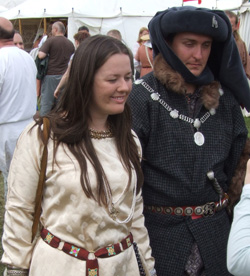
Garments must be made of natural fiber textiles – wool, linen, silk, and cotton. Avoid polyester and other modern, synthetic fabrics.
Where visible on garments being worn, hand-stitching is preferred to machine stitching.
Costumes should adhere as closely as possible to documented period patterns and practice.
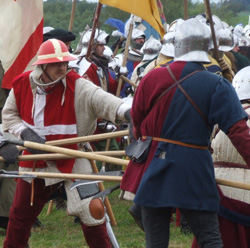
Use armor made of period materials – steel, iron, boiled leather, and so forth. Avoid modern substitutes like aluminum, stainless steel, and plastic. In particular, avoid aluminum maille.
Keep impressions within as close a time-frame as possible; i.e. don’t mix clothing and armor components from widely divergent periods. For example, wearing a circa 1590 burgonet with a 1350 coat-of-plates would be inappropriate.
|
|
|
|
|
Match weapon styles to costuming appropriate to the periods in which those weapons were used. Weapons should be made of period appropriate materials, styles, and techniques unless safety considerations require otherwise.
The before-mentioned standards for fabrics and stitching apply to flags, banners, and pennants. Avoid synthetic fabrics and printed designs.
Wear of impression-appropriate period style footwear is very strongly encouraged.
For those needing correction of vision, wear of contact lenses is much preferable to the wear of modern eyeglasses. Even wear of period-correct reproduction eyewear is discouraged due to the scarcity of such during the periods being portrayed. Medical or safety considerations may trump historical concerns in this regard, however. At the very least, avoid sunglasses.
|
|
|
|
|
|
Groups of people portraying the same time period and location may want to conduct themselves in first-person style, using period-appropriate language and behavior. However, because of the wide range of periods represented and our public educational objectives, this is not an immersion event and such behavior will not be required. In other words, I require no one to speak Latin or 10th Century Norse, and don’t expect me to converse in Middle English or Norman French.
|
|
|
|
Tents should be made of natural fibers – avoid synthetic fabrics, nylon ropes, and such. Hemp is the ideal rope component. Tents should adhere to documented styles and should match the period being portrayed by their inhabitants.
Period style lighting must be used; i.e. candles, reeds, and oil lamps of styles used in the periods being portrayed. Modern camping lanterns, railroad lanterns, and electrical lighting of all types are prohibited. If completely concealed, flashlights may be kept in camp for use during genuine emergencies.
Use of electronic devices is very strongly discouraged in the camp and demonstration areas when the site is open to the public. This includes phones and all other digital communication devices – except in health and safety emergencies. If you must make a call, send a text message, or check the internet, please go to the vehicle parking area to do so. If you are expecting contact, at least limit the device to the vibrate mode and conduct your business in a closed tent.
Modern camping amenities – sleeping bags and coolers – may be used. However, they must be kept completely out of public sight when the site is open to the public. Sleeping bags must be stowed in a box, fully concealed under period bedding, or stored in a modern vehicle when not in use. Coolers must be concealed in similar fashion.
Bedding straw will be provided in bales. Do not use bales as seating! Break them up and use the straw (or hay) as flooring in tents or as bedding.
Camp furniture – chairs, tables, boxes, beds, and such – must conform to documented styles, materials, and construction techniques matching the period being portrayed. In particular, avoid the two-piece camp chairs popular with many reenactors of various periods. These chairs date from only the mid-20th century.
|
|
|
|
|
|
Cooking must be limited to documented or reasonably period-correct style foodstuffs, techniques, and utensils. Modern camp stoves may not be used. Generous supplies of firewood will be provided – please use it. Due to fire safety concerns, campfires will be permitted only in designated spaces, of which there will be many. Keep modern-day food and beverage packaging to a minimum as required to maintain health safety. Dispose of packaging and food scraps as quickly as possible in the trash receptacles that will be provided. Please do not bring modern carry-out food – pizza, burgers, and that sort of thing – into the camping area.
Use period style eating utensils and tableware whenever possible. Avoid plastic and foam plates, bottles, cups, knives, forks, and such. Water will be provided from a central source in abundance. Please transport, store, and consume it using period style containers.
|
|
|
|
|
Modern-day tattoos must not be visible when wearing period costume. Only tattoos appropriate to and essential for particular historical impressions may be visible.
Smoking and use of other tobacco products are prohibited in camp when the site is open to the public. If you must use tobacco, please go to the parking area to do so. Participants are informed that consumption of alcoholic beverages in City of Frankfort parks is illegal, and cases of extreme, disruptive, or unsafe drunkenness may be dealt with by parks personnel or law enforcement officers.
|
|
|
|
Hair styles should adhere as closely as possible to those documented for the periods being portrayed.
Persons portraying roles historically limited to persons of the other sex should conceal their gender as well as possible when in public view. (OK, so we’ll have a bunch of Joan-of-Arc impressions, won’t we?)
Separate standards concerning matters of safety will be published and must be observed.
|
|
|
|
|
|
Violations of the standards of historical accuracy stated here will be dealt with in an escalating scale of enforcement. A disapproving frown will greet initial violations. Uncorrected violations will be met with firm but privately expressed verbal admonitions. Those who fail to respond to those admonitions will be subject to confinement in the public stocks. Those who remain uncooperative will be drawn to a public site; hanged by the neck; cut down before they are dead; have their entrails cut out and burned before their eyes; suffer beheading; and have their remains quartered and posted upon pikes at prominent locations about the camp. We assume that their heirs and assigns will correct the noted offenses in short order. Actually – we expect positive, cooperative attitudes, personal dedication to the cause of historical accuracy, and peer pressure to enforce our rather liberal standards of historical accuracy.
|
|
|
 |
|
|
|
|
|
© 2012 - 2013 ALL RIGHTS RESERVED
Website Designed and Maintained by Graphic Enterprises
|
|
|
|